Why one degree is a lot
It sounds tiny. Over a few metres it is the difference between level and noticeably off.
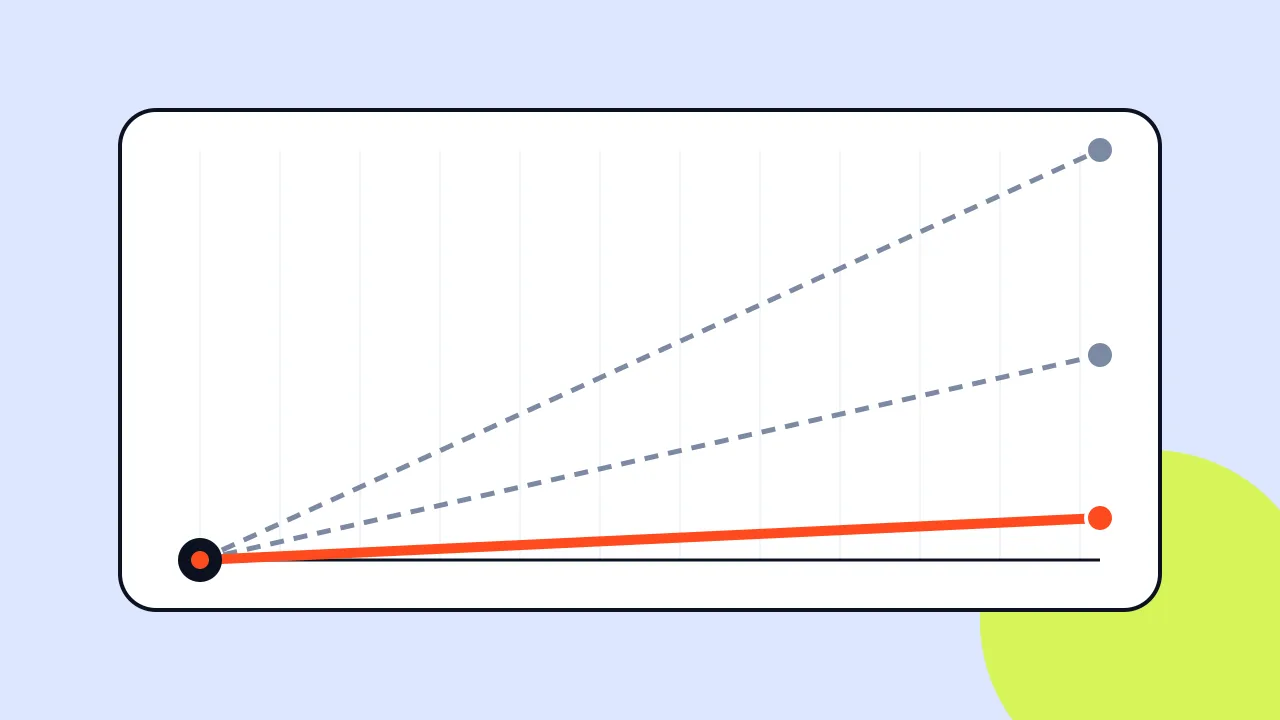
The one formula
The error you see at a distance is distance × tan(angle). For small angles that is close to angle in radians, so each degree is about 17.5 mm per metre.
What that looks like
- 0.1° gives 1.7 mm per metre, 21 mm at 12 m
- 0.5° gives 8.7 mm per metre, 105 mm at 12 m
- 1° gives 17.5 mm per metre, 209 mm at 12 m
On a 3 m wall, a 1° tilt puts one end of a shelf 52 mm lower than the other. That is plainly visible; 0.1° would be 5 mm, which most eyes forgive.
Why hands drift
A bubble level is excellent when you hold it still, but holding a level still while you read it and mark a line is harder than it sounds. The reading and the marking happen at different moments.
What a laser changes
A self-leveling laser lets gravity hold the reference while your hands are busy with the pencil. Its limit is the pendulum range and the sensor resolution, which is why the concept has a ±5° stop and a 0.1° readout.
Drag the sliders in the drift chart to see how any angle error grows with distance.